
Throughout history, industrial revolutions have transformed the way people live, work, and conduct business. The First Industrial Revolution introduced mechanized production through steam power. The Second Industrial Revolution brought electricity, mass production, and assembly lines. The Third Industrial Revolution introduced computers, automation, and the internet, fundamentally changing communication and business operations.
Today, the world is witnessing another major transformation driven by Artificial Intelligence (AI). Often referred to as the Fourth Industrial Revolution, AI is reshaping industries, improving productivity, and changing how organizations make decisions. Unlike previous technological advances that primarily automated physical labor, AI has the ability to automate cognitive tasks, analyze massive datasets, recognize patterns, and support intelligent decision-making.
From healthcare and education to manufacturing, finance, agriculture, transportation, and digital marketing, AI is becoming an essential tool for innovation and economic growth. Businesses that embrace AI can improve efficiency, reduce operational costs, deliver personalized customer experiences, and remain competitive in a rapidly evolving marketplace.
This article explores why Artificial Intelligence is considered the next industrial revolution, its impact on industries, the opportunities it creates, the challenges it presents, and how businesses can prepare for an AI-driven future.
Understanding Artificial Intelligence
Artificial Intelligence refers to computer systems capable of performing tasks that typically require human intelligence. These tasks include
- Learning from data
- Solving complex problems
- Understanding natural language
- Recognizing images and speech
- Making predictions
- Automating repetitive tasks
- Supporting business decisions
Modern AI combines technologies such as-
- Machine Learning (ML)
- Deep Learning
- Natural Language Processing (NLP)
- Computer Vision
- Generative AI
- Robotics
Unlike traditional software that follows fixed instructions, AI systems continuously improve as they process more information.
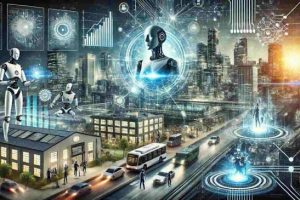
Why AI Is Called the Next Industrial Revolution
Every industrial revolution has fundamentally changed economies and societies.
Artificial Intelligence represents the next industrial revolution because it transforms not only manufacturing but nearly every industry and profession.
Several factors make AI revolutionary-
- Automation of knowledge-based work
- Faster and more accurate decision-making
- Continuous learning from data
- Increased productivity
- Personalized customer experiences
- Innovation across multiple industries
- Creation of entirely new business models
Rather than replacing machines alone, AI enhances both machines and human capabilities.
How AI Is Transforming Major Industries
1. Healthcare
Healthcare is experiencing remarkable improvements through AI.
Applications include-
- Early disease detection
- Medical image analysis
- Personalized treatment recommendations
- Drug discovery
- Remote patient monitoring
- Virtual health assistants
AI helps healthcare professionals make faster and more informed decisions while improving patient outcomes.
2. Manufacturing
Manufacturing has become smarter with AI-powered automation.
Key benefits include-
- Predictive maintenance
- Quality inspection using computer vision
- Industrial robots
- Production optimization
- Supply chain forecasting
Factories increasingly rely on AI to reduce downtime, improve product quality, and increase operational efficiency.
3. Finance
Financial institutions use AI for-
- Fraud detection
- Credit risk analysis
- Algorithmic trading
- Investment recommendations
- Customer service chatbots
- Financial forecasting
AI processes large volumes of financial data much faster than traditional systems.
4. Retail and E-commerce
Retail businesses use AI to improve customer experiences.
Applications include-
- Personalized product recommendations
- Inventory management
- Dynamic pricing
- Customer support automation
- Demand forecasting
These technologies increase customer satisfaction while improving business profitability.
5. Education
AI is making education more accessible and personalized.
Examples include-
- Intelligent tutoring systems
- Personalized learning platforms
- Automated grading
- Language learning assistants
- Student performance analysis
Teachers benefit from reduced administrative work while students receive more individualized learning support.
6. Agriculture
AI helps farmers improve productivity and sustainability.
Common applications include-
- Crop monitoring
- Disease detection
- Weather prediction
- Precision irrigation
- Harvest forecasting
- Soil analysis
These innovations support higher crop yields while reducing resource waste.
7. Transportation
Transportation systems are becoming safer and more efficient through AI.
Applications include-
- Route optimization
- Traffic prediction
- Fleet management
- Driver assistance systems
- Autonomous vehicle development
- Predictive maintenance
These technologies reduce fuel consumption, improve logistics, and enhance road safety.
8. Digital Marketing
Digital marketers increasingly depend on AI to improve campaign performance.
AI supports-
- Customer segmentation
- Content generation
- Predictive analytics
- Personalized advertising
- Marketing automation
- Chatbots
- Email optimization
Businesses can better understand customer behavior and deliver highly relevant marketing campaigns.
Benefits of AI for Businesses
Organizations adopting AI enjoy several competitive advantages.
Increased Productivity
AI automates repetitive tasks, allowing employees to focus on creative and strategic work.
Better Decision-Making
AI analyzes enormous datasets quickly and identifies valuable insights that support informed business decisions.
Cost Reduction
Automation lowers labor costs, minimizes operational errors, and improves efficiency.
Improved Customer Experience
AI enables personalized recommendations, faster customer support, and customized marketing campaigns.
Higher Accuracy
AI systems reduce many forms of human error in forecasting, quality inspection, and data analysis.
Continuous Operation
Unlike humans, AI-powered systems can operate 24 hours a day without interruption, improving service availability and operational efficiency.
AI and the Future of Work
One of the most discussed aspects of AI is its impact on employment.
AI will automate certain repetitive tasks, but it is also expected to create new roles requiring skills in-
- AI development
- Data science
- Machine learning
- Cybersecurity
- AI ethics
- Human-AI collaboration
- Digital transformation
Rather than replacing every job, AI is likely to change how people work by handling routine activities while humans focus on creativity, leadership, and complex problem-solving.
Continuous learning and skill development will become increasingly important.
Challenges of the AI Revolution
Despite its enormous potential, AI also presents important challenges.
Data Privacy
AI systems rely heavily on data, making responsible data collection and protection essential.
Ethical Concerns
Organizations must address-
- Algorithmic bias
- Fairness
- Transparency
- Accountability
- Responsible AI development
Workforce Adaptation
Businesses need to help employees develop new skills to work effectively alongside AI technologies.
Cybersecurity Risks
AI systems themselves must be protected against cyberattacks, data breaches, and malicious manipulation.
High Implementation Costs
Developing AI infrastructure often requires investment in technology, talent, and ongoing maintenance.
Preparing for the AI Revolution
Businesses should adopt AI strategically rather than simply following trends.
Recommended steps include-
- Identify business challenges AI can solve.
- Start with pilot projects.
- Invest in employee training.
- Ensure high-quality data management.
- Maintain transparency in AI systems.
- Monitor AI performance continuously.
- Prioritize ethical and responsible AI practices.
Organizations that combine human expertise with AI capabilities are more likely to achieve sustainable success.
The Future of Artificial Intelligence
Artificial Intelligence will continue evolving over the coming years.
Future developments may include-
- More intelligent virtual assistants
- Smarter factories
- Fully autonomous logistics systems
- Personalized healthcare at scale
- AI-powered scientific research
- Advanced cybersecurity solutions
- Sustainable energy optimization
- More accessible AI tools for businesses of all sizes
As computing power increases and AI models become more capable, the technology will influence nearly every aspect of business and society.
Why Businesses Should Embrace AI Today
Companies that begin adopting AI now can gain significant competitive advantages.
Benefits include-
- Faster innovation
- Better customer experiences
- Improved operational efficiency
- More accurate forecasting
- Stronger competitive positioning
- Greater scalability
- Enhanced profitability
Waiting too long to adopt AI may make it harder for businesses to compete in increasingly digital markets.
Artificial Intelligence is more than just another technological advancement—it represents a new industrial revolution that is reshaping economies, industries, and the future of work. Like the steam engine, electricity, and the internet before it, AI has the potential to redefine productivity, innovation, and global competitiveness.
Across healthcare, manufacturing, finance, education, agriculture, transportation, retail, and digital marketing, AI is helping organizations automate processes, improve decision-making, reduce costs, and deliver better customer experiences. At the same time, businesses must address important challenges related to privacy, ethics, workforce development, and responsible AI governance.
The future of AI is not about replacing human intelligence but enhancing it. Organizations that combine human creativity, critical thinking, and expertise with the analytical power of AI will be best positioned to thrive in the next industrial revolution. By embracing innovation responsibly and investing in continuous learning, businesses and individuals can unlock the full potential of Artificial Intelligence and shape a smarter, more productive, and more sustainable future.